On the eastern edge of Liverpool city centre, between the Ropewalks and the Knowledge Quarter, sits a grid of brick terraces that has survived two centuries of boom, decline and recovery. The Georgian Quarter, sometimes called Canning after one of its best known streets, is almost entirely residential and still very much lived in.
Built on merchant money
The area was laid out in the late eighteenth and early nineteenth centuries for the town's wealthiest families, many of them merchants whose fortunes came from the port. On Rodney Street, Historic England's listing for No. 62, a Grade II* house of 1792 to 1793, records that it was built for the merchant John Gladstone and that his son, the future Prime Minister William Ewart Gladstone, was born there on 29 December 1809. The same entry is frank about where much of that wealth came from: it notes the family's West Indian plantations, the compensation paid to them after emancipation, and the street's wider connections with the slave trade.
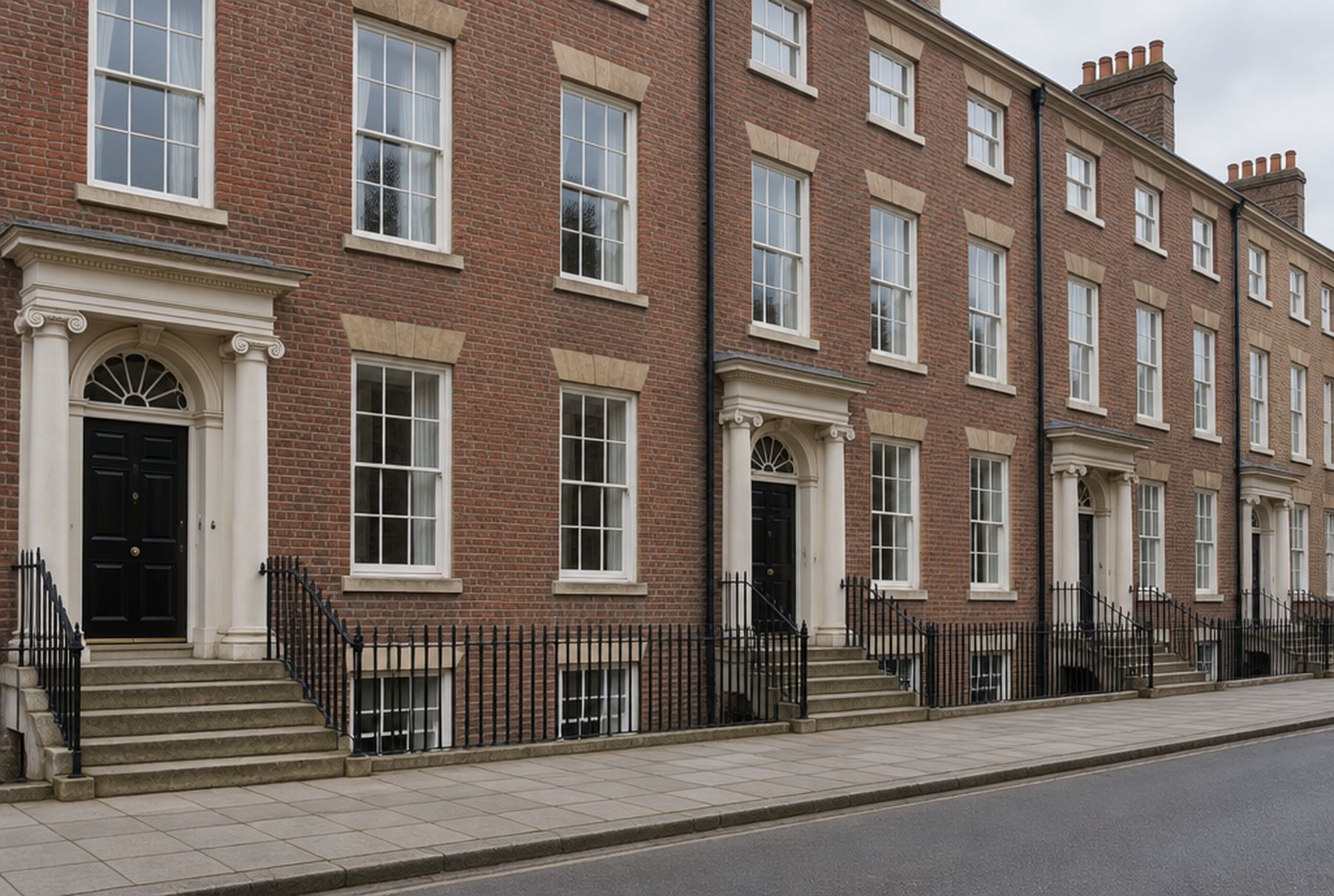
Further east, Canning Street shows the quarter at its most regular. Nos. 1 to 19, a Grade II listed terrace of the 1830s, are typical: three storeys over a basement, sash windows, Ionic doorcases and plain iron railings. Through the twentieth century much of the area fell into poor repair. Its recovery owed a good deal to a restoration programme covering more than 100 Georgian houses and nine terraces in the Canning Street Conservation Area, with 105 owners taking part, which received a Europa Nostra diploma. Rodney Street, Canning Street and Mount Pleasant are all among the city's conservation areas today.
Hope Street and the two cathedrals
Hope Street runs along the quarter's western side with a cathedral at each end. Liverpool Cathedral, designed by Giles Gilbert Scott, had its foundation stone laid by King Edward VII in 1904 and was marked as complete at a thanksgiving service on 25 October 1978. At the northern end, the Metropolitan Cathedral of Christ the King, built to Frederick Gibberd's design and opened in May 1967, stands on the crypt Edwin Lutyens began in 1933. It was upgraded to Grade I in June 2025.
Between them are Herbert Rowse's Philharmonic Hall, opened in June 1939, and the Everyman Theatre, whose rebuilding by Haworth Tompkins won the RIBA Stirling Prize in 2014. Restaurants, bars and the shops of the city centre are within walking distance.
What renters should know
- Many of the larger houses are now divided into flats, so expect high ceilings and tall windows, but also stairs, older layouts and fewer lifts.
- Period homes can be harder to heat. Ask to see the Energy Performance Certificate and how the home is heated before you commit.
- Since 1 May 2026, under the Renters' Rights Act, new tenancies are periodic, a landlord can ask for no more than one month's rent in advance, and offers above the advertised rent cannot be accepted. You can also ask to keep a pet, and your landlord must consider the request.
If you are looking for a home in the area, you can register your search with us.
What landlords should know
The Office for National Statistics does not publish rents for individual neighbourhoods. For Liverpool as a whole, the average private rent reached £913 a month in August 2026, up 5.6% on a year earlier, with one bedroom homes at £686 and two bedroom homes at £837. A well kept period flat a few minutes from the cathedrals is a different proposition from the city average, which is why we never rely on an automated figure.
Listed buildings and conservation areas bring their own responsibilities. Works that affect a listed building's character need listed building consent. Government guidance says a listed building, or one in a conservation area, may not need an EPC where meeting minimum energy performance requirements would unacceptably alter its character or appearance, and suggests asking the council's conservation officer if in doubt. Liverpool's current selective licensing scheme covers around 80% of privately rented homes and runs until March 2027, and the council has consulted on what comes next, so check whether your address needs a licence.
Our property management service handles the compliance, repairs and tenants day to day, and guaranteed rent pays you an agreed sum every month instead. For a figure for your own home, use our rent calculator and a property manager will come back to you, or read more on our Liverpool page.
Sources: Historic England, 62 Rodney Street (list entry 1072958); Historic England, 1 to 19 Canning Street (list entry 1068363); European Heritage Awards archive, Canning Street Conservation Area, Liverpool; Liverpool City Council, Conservation areas; Liverpool Cathedral, Our history; Taking Stock, Metropolitan Cathedral of Christ the King, Liverpool; Liverpool Philharmonic, Philharmonic Hall; RIBA, Stirling Prize winners; GOV.UK, Renters' Rights Act overview for tenants; GOV.UK, A guide to Energy Performance Certificates for the marketing, sale and let of dwellings; Liverpool City Council, Selective licensing consultation; ONS, Housing prices in Liverpool.